


Recent Updates
Roland “A Foundation For Electronic Music” Series (1979)
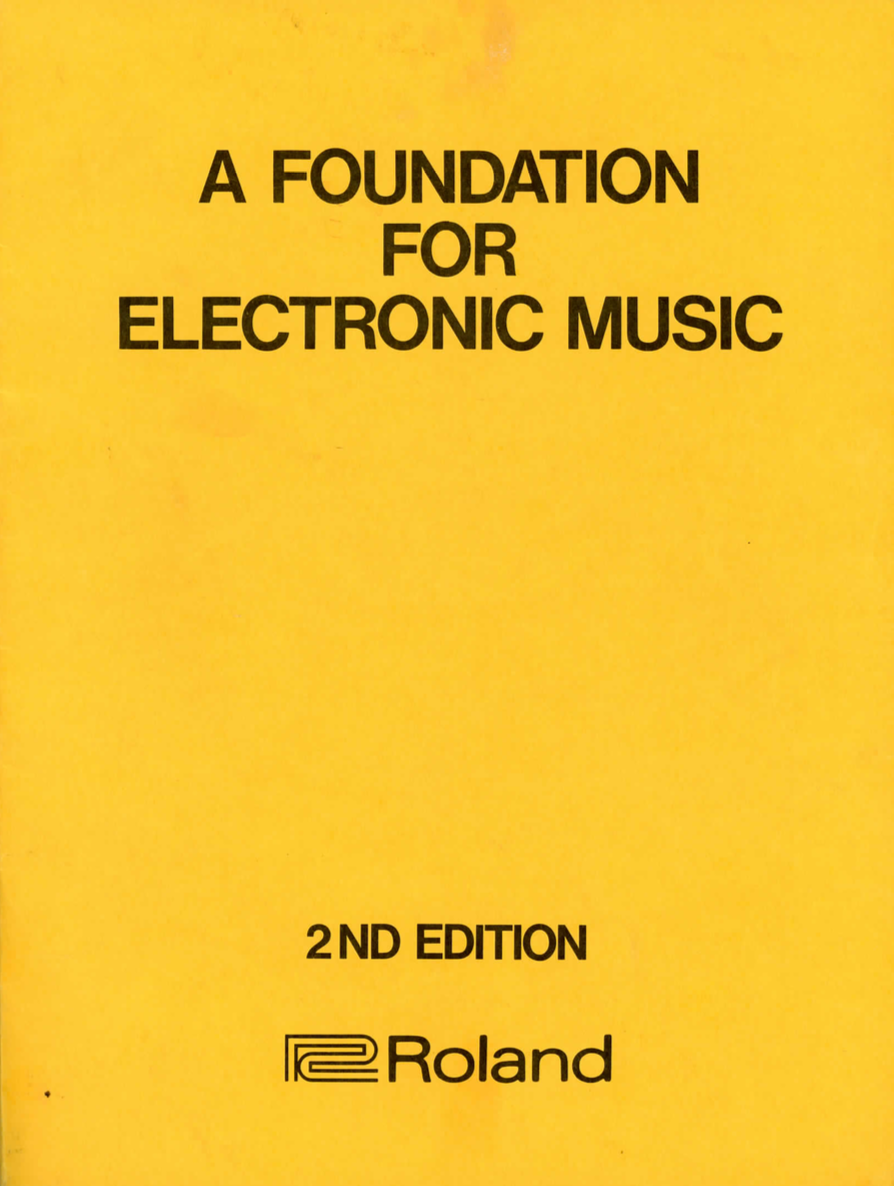

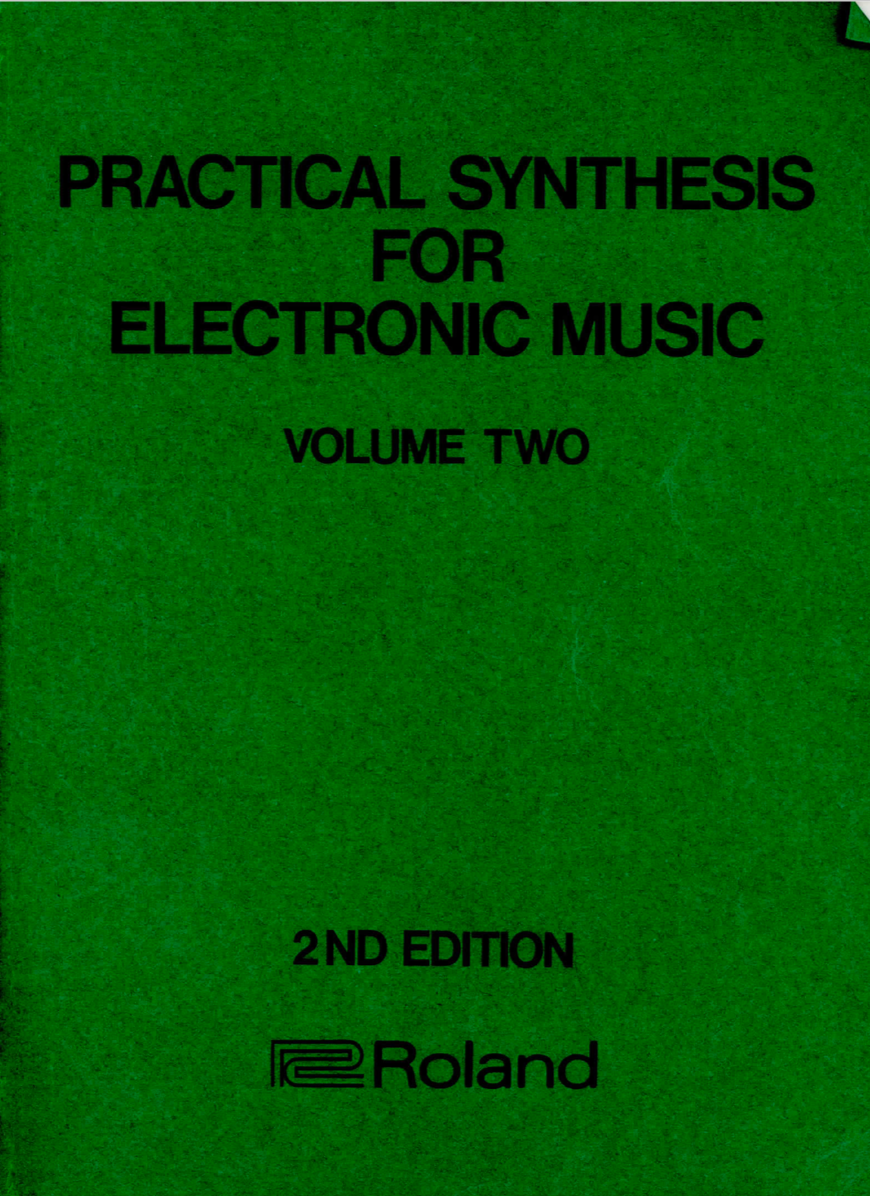
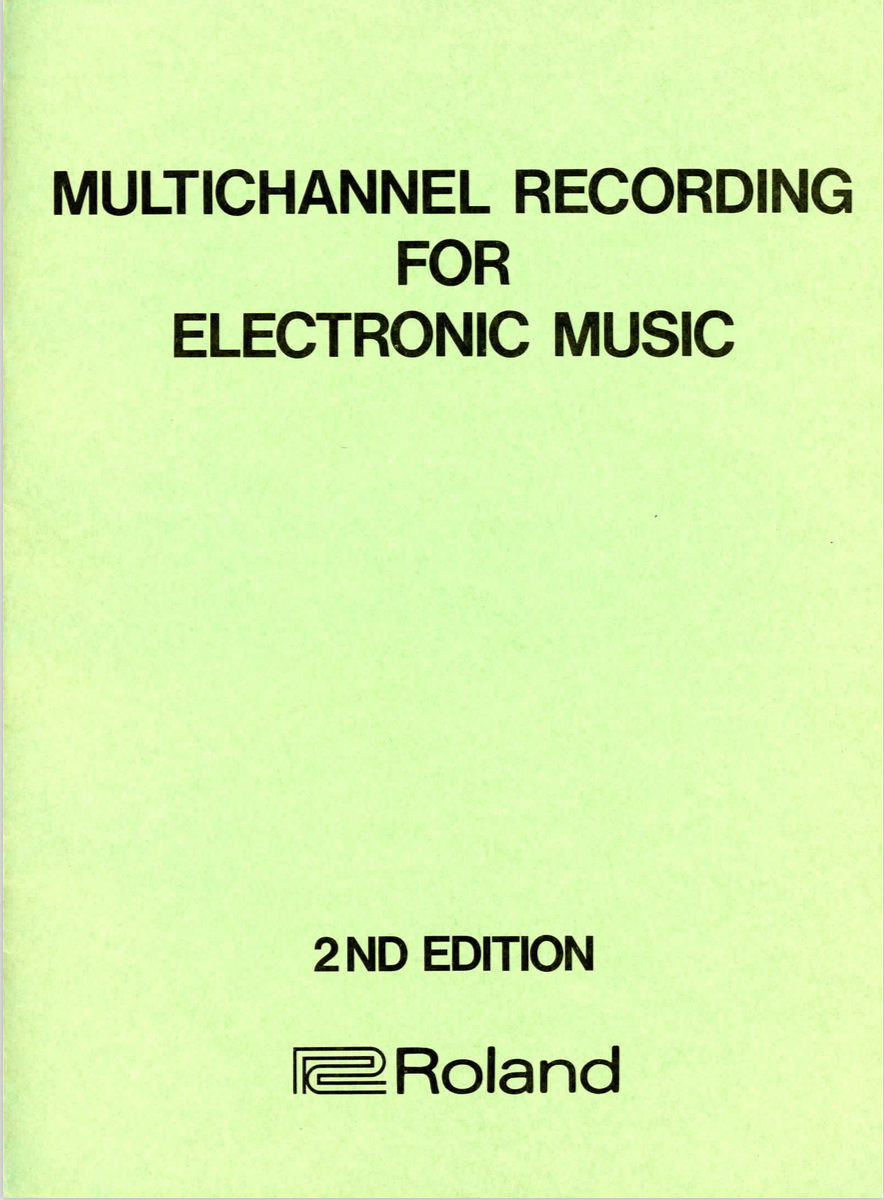
Interactive Musical Hexagons

10 Rules For Students and Teachers From John Cage
 John Cage, 10 Rules for Students and Teachers
RULE ONE: Find a place you trust, and then try trusting it for a while.
RULE TWO: General duties of a student: pull everything out of your teacher ; pull everything out of your fellow students.
RULE THREE: General duties of a teacher: pull everything out of your students.
RULE FOUR: Consider everything an experiment.
RULE FIVE: Be self-disciplined: this means finding someone wise or smart and choosing to follow them. To be disciplined is to follow in a good way. To be self-disciplined is to follow in a better way.
RULE SIX: Nothing is a mistake. There’s no win and no fail, there’s only make.
RULE SEVEN: The only rule is work. If you want it to lead to something. It’s the people who do all of the work.
RULE EIGHT: Do not try to create and analyze at the same time. They’re different processes.
RULE NINE: Be happy whenever you can manage it. Enjoy yourself. It’s lighter than you think.
RULES: We’re breaking all the rules. Even our own rules. And how do we do that? By leaving plenty of room for X quantities.
HINTS: Always be around. Come or go to everything. Always go to classes. Read anything you can on your hands. Look at movies carefully, often. Save everything. It might come in handy later.
Bring Da Noise: A Brief Survey of Sound Art – Kenneth Goldsmith
Over the past few years, sound art has been more visible in America. The Whitney has been including it in its Biennials and it even had its own section in their “The American Century” retrospective a few years ago. As a matter of fact all over the country, it’s not too unusual to walk into a museum, art gallery, or university-sponsored exhibition space and hear nothing but sound. Websites like my own UbuWeb, the San Francisco-based Other Minds, and numerous independent sites of American composers are sprouting up, offering dozens of hours worth of sound art MP3s for free. Once relegated to specialty shops like Printed Matter, Inc. even record stores seem to be carrying these sort of discs. If you’re interested in sound art, a trip to Other Music in New York City or to the new airplane-hanger sized Amoeba in Los Angeles will prove fruitful, with offerings from everyone from Vito Acconci to Mike Kelley cramming the racks.
Having helped curate some of these shows at the Whitney, I’ve found it’s a difficult thing to define what sound art is. Where does, say, experimental music end and sound art begin? Or, take spoken word: can a sound poem—language meant to be heard not necessarily seen—be construed as sound art? But what about opera that slides into performance art? It’s a fabulous mess, where the lines are ill-defined and disciplines overflow into one another and co-mingle in ways that are not easily categorized.
Any survey of this stuff is going to be messy. And incomplete… It’s such a vast field that I’m bound to miss a lot of work that, say, you might consider vital. Fair enough. Let’s call it a start. What follows is a subjective first attempt at breezy chronology from 1902-2002 (when I lecture on this the title of my talk is“100 Years of Sound Art in 90 Minutes”). I don’t have room to talk about more than one or two pieces by each artist. Frankly, every artist here deserves a monograph about him or herself (and many already have one).
We’ll start in Paris with Erik Satie, Marcel Duchamp and the early Futurists, and then look at how experimental literature connects to sound art. The story pretty much stays in Europe until the end of World War II, when the art world packs up and moves to New York. By the early ’60s, the whole scene shifts to America for the next two decades, kicked off by the publication of John Cage’s Silence. From there we’ll make our way through the various art movements, to performance scenes, gallery scenes, clubs, and TV shows. Other history meets up with everyone from Karen Finley to Marie Osmond and Michael Jackson, and winds up in the digital age when much of the action has migrated onto our vast computer networks. Finally, we’ll take a brief tour of a few fascinating projects I’ve recently come across.
I’ve always loved the art world. It’s a place where actors who are too weird to make it on Broadway end up as performance artists; writers that don’t write conventionally end up as text artists; and musicians who fall outside of mainstream concerns—be it jazz, classical, or rock—end up as sound artists. I love things that fall in between the cracks. I love people working outside of their disciplines, working outside of what they know. It drove punk rock — DYI: It’s one of the great paths to innovation. And what follows is an edgy survey of informed ignorance; people busting down walls of sound in the name of art.
The Futurist Moment: Howlers, Exploders, Crumplers, Hissers, and Scrapers
In the midst of an art opening at a Paris gallery in 1902, ambient music was born. Erik Satie and his cronies, after begging everyone in the gallery to ignore them, broke out into what they called Furniture Music—that is, background music—music as wallpaper, music to be purposely not listened to. The patrons of the gallery, thrilled to see musicians performing in their midst, ceased talking and politely watched, despite Satie’s frantic efforts to get them to pay no attention. Cut to 1913, the year that the literary critic Marjorie Perloff calls “The Futurist Moment.” Across Europe, the avant-garde is peaking in its most extreme forms. Painting, sculpture, performance, poetry, dance and sound works are all pushing the limits. Let’s listen in to what was happening around that crucial moment.
In Russia, the experiments of Velimir Khlebnikov (1885-1922) and Aleksei Kruchenykh (1886-1968) were among the first to abstract language in a way that we would term “concrete” today (i.e. it’s more important how the words sound than what they mean). They even invented a name for it, zaum, which like its later incarnation, Dada, was shorthand for a “transrational” language. Listening to these poems, you’ll hear invented words, neologisms, fragments; in short, the whole of what came to be later known as “sound poetry” is contained in these pioneering works.
In Italy, the Futurists were working along similar lines. Futurist ringleader F.T. Marinetti (1876-1944) invented the concept of parole in liberta, which roughly translates into “words in freedom.” Marinetti’s scope included the page as well as the sound; he did some of the first typographical experiments—words floating around on the page, freed from the “tyranny” of the paragraph, stanza, or line. In a recording of his most famous poem, “Bombardamento di Adrianopoli,” (1926) we can hear Marinetti actually performing the sounds of the battlefield with his mouth: machine guns rattle and canons boom. The score for the piece, from which Marinetti reads, is a stunning graphic work, with letters of different sizes, all flying around the page.
Another important Futurist was Luigi Russolo, whose 1913 manifesto, The Art of Noises, opened the possibilities of incorporating “noise” into music. In it he claimed, “We enjoy creating mental orchestrations of crashing down of metal shop blinds, slamming doors, the hubbub and shuffle of crowds, the variety of din from the stations, railways, iron foundries, spinning mills, printing works, electric power stations and underground railways.” His Awakening of a City (Risveglio di una citta, 1914) was played on a battalion of noise machines that he called intonarumori, designed by Russolo himself to mimetic industrial sounds. There were 27 different types of instruments, each producing a different racket. They had great names: “howlers,” “exploders,” “crumplers,” “hissers,” and “scrapers.” There’s a famous photo of Russolo and his assistant Piatti standing amidst a roomful of intonorumori: boxes of varying sizes, each fitted with a huge conical metal speaker. From the looks of it, you had to crank a handle – not unlike a Victrola – in order to get it to make a sound. Russolo’s work would prove to be essential; without him, the likes of John Cage, Pierre Schaeffer, Edgard Varèse or Nine Inch Nails wouldn’t be possible.
George Antheil‘s Ballet Mécanique, written in 1925 to accompany an abstract silent film by the artist Fernand Leger was also key in terms of admitting extra-musical sounds into music. The racous score — which included a pianola, two or more pianos, three xylophones, four bass drums, tamtam, siren, a battery of electric bells, and three airplane propellers — caused a riot during its Paris premiere. American composers such as Charles Ives and Edgard Varèse were also hammering out new ways of thinking about sound, a movement which spread like wildfire across the Americas to include composers like Silvestre Revueltas in Mexico, Amadeo Roldan in Cuba, and Carlos Chavez in Mexico. So powerful was the work of these artists that they occasionally appear in concert-hall repertoire around the world.
There’s a wonderful recording of Marie Osmond reciting Hugo Ball‘s sound poem “Karawane” (1916) made in the early ’80s for a segment of the television show Ripley’s Believe It or Not. While she doesn’t do a great job with it (try Canadian Christian Bök’s for the definitive version), it’s a reminder of how this stuff is never too far below the surface of popular culture. Along with Emily Hennings, Ball (1886-1926) founded the Cabaret Voltaire in Zurich, which only lasted five months but spawned the Dada movement. “Karawane” was one of the last events held at the Cabaret. For it Ball place his texts on music stands scattered all over the podium and turned from one to another during the performance, raising and lowering the cardboard “wings” of his costume.
The Cabaret Voltaire was a hotbed of performance poetry, which was often recited by several voices, all screaming at once. The most famous of these poems, “L’amiral Cherche Une Maison à Louer” (1916) featured Marcel Janco, Hugo Ball, Richard Huelsenbeck, and Tristan Tzara all whistling, singing, grunting, coughing, and speaking at the same time. It was the first instance of what Fluxus artist Dick Higgins later would call intermedia, which morphed into Happenings and later into performance art.
Raoul Hausmann (1886-1971) invented what he called “optophonetics” which, like Marinetti, used typographic variations in size to indicate the spoken variations of pitch and volume of a score when performed. In 1916, after hearing Hausmann’s poems, Kurt Schwitters, too, jumped into the act and built up a totally abstract piece called “Sonata in Urläten.” Over the years, the “Sonata” grew in both size and variation, finally becoming the stunning Ursonate (1926). Often acknowledged as the greatest sound poem ever written, it clocks in at around 40 minutes. For many years, there had only been snippets of Schwitters reading his masterpiece, but in the early ’90s, a full-length tape recorded in the 1930s surfaced in an attic in Holland. It was finally released on CD by Wergo in 1993.
Although most people know Marcel Duchamp as a visual artist, few are aware of his small, but important musical output. Again, most of his activity in music was part of the Futurist movement, taking place between 1912 and 1915. He created an aleatory vocal piece for three voices, “Erratum Musical,” which was included in the Green Box Duchamp published in 1934. It’s undated, but historians have pinned it to somewhere around 1913. It was originally written with Duchamp’s three sisters in mind. To compose it, he made three sets of 25 cards, one for each voice, with a single note per card. Each set of cards was mixed in a hat; he then drew out the cards from the hat one at a time and wrote down the series of notes indicated by the order in which they were drawn. Another work, “La Mariée mise à nu par ses célibataires même. Erratum Musical” (The Bride Stripped Bare by Her Bachelors Even. Erratum Musical), belongs to a series of notes and projects that Duchamp started to collect around 1912. It was written using numbers, instead of notes, and Duchamp prescribes an elaborate mechanical procedure to generate the score. It’s an insane process: you need to get several open-top railroad cars, a set of numbered balls, and a funnel. Each ball represents a note (pitch) and these balls have to fall through the funnel into the cars passing underneath it at various speeds. When the funnel is empty, the composition is completed. Needless to say, it’s a different piece each time it’s “composed” and played. This lack of definitive versioning would resonate later in remix culture.
The photographer Man Ray, too, while primarily known as a visual artist, created a score called Lautgedicht “Sound Poem” (1924). The score is simply a poem that Ray found and crossed out, word by word. Dutch sound poet Jaap Blonk did a fantastic rendition of it recently by interpreting the lengths of the crossed-out lines as durational elements; he simply intones every duration in an obnoxious, nasally, guttural honk which lasts about seven minutes. I’ve played it in full on the radio on my WFMU show and it never fails to light up the phone, mostly with listeners begging me to take it off.
Sound and The Literary Connection
Before moving onto the fast-paced developments following World War II, let’s quickly throw avant-garde literature into the story. Figures like James Joyce and Gertrude Stein would become crucial to sound artists and composers from the 1960s onward, manifesting their linguistic play in figures like Bruce Nauman and Laurie Anderson.
Sub Rosa Records recently released the entire recorded works of James Joyce (reading his own text). The CD amounts to two short cuts: one scratchy section of Ulysses and the famous “Anna Livia Plurabelle” chapter from Finnegans Wake. The Wake is as much of a multimedia work as you could create without ever leaving the page. While listening to James Joyce read it, you realize that it’s a sound poem as well as a work of sound art. When he made the recording, shortly before his death, he was almost blind and had to read the chapter from massive cards which were held up before him, making his reading of the work an early act of performance art in and of itself.
Gertrude Stein’s readings of her circuitous work can be seen as precursors to minimalism and structuralism in the latter half of the 20th century; it’s no stretch to extend her repetitious experiments to the use of tape loops and samples later on. Stein sculpts with language. In her rendition of her poem, “If I Told Him, a Completed Portrait of Picasso,” recorded in 1934-35, there’s a gradual accumulation of language, bit by bit, in order to form a scaffolding of her subject. Mirroring Picasso‘s cubistic painting process, a definition is formed obliquely, more by suggestion than by description. And, in fact, although Picasso not too often thought of as a writer, a collection of his poetry appears on UbuWeb, which clearly links him to literary figures like Gerturde Stein. The circular quality of his writing places him as a precursor of minimalism, tape loops, and sampling as well.
Although a lot of literary work was done that had sound-based elements (Ezra Pound‘s reading of “Usura” from The Cantos, Ogden Nash‘s quippy poetry set to hammy orchestrations, and the howls and groans of the Beat generation), let’s fast forward to the early 1970s, when literature directly ran into dialogue with sound. Richard Kostelanetz fashioned a rag-tag group of composers, poets, and visual artists into a movement that he called “text-sound.” The idea was that in order to really “get” the poem, you had to hear it, although it simultaneously existed on the page. Primary practitioners of sound-text works included the legendary radio-personality Charles Amirkhanian and the Canadian-based group The Four Horsemen, featuring the talents of Steve McCaffery, bp Nichol, Raphael Barreto-Rivera, Paul Dutton, all of whom went on to illustrative careers both on and off the page.
A Chance Meeting of a Defective Tape Machine and a Migraine
Buckminster Fuller has pointed out that wars drastically speed up the pace of technological innovation. The upside is that after wars end, those innovations are immediately adapted for civilian use: so it was with the tape recorder. In 1948, the French composer Pierre Schaeffer formulated the theory of musique concrète or tape music. By rhythmic acceleration and deceleration, changing the pitch and dynamics, and modifying the nature of the instrumental timbre, suddenly sound was freed from traditional notation and instrumentation. Like the Russian Futurist’s use of language, sound was freed from its long-held conventions and the field was rife with new possibilities. His “Etude aux Chemins de Fer” from 1948, demonstrates just how much can be done with the mundane sounds of a railway station. The cyclical rhythms inherent in railroading become elements of looped minimalism, whistles become flutes, and what sounds like the wheels on the tracks are transformed into xylophones.
In Cologne at the WDR studios in the mid-1950s, Karlheinz Stockhausen was working toward similar ends using different means: electronic music. His Gesang der Jünglinge (1956) gives an electronic treatment to human voices and alters them in ways that the Russian Futurists could only dream of. In addition to the extensions of the human voice, Stockhausen presented the work through five loudspeaker groups arranged around a concert hall, thus opening up a spatial element to sound art.
The curious thing is that, in general, sound art quietly absorbed these technological breakthroughs into its practice, but rarely made them their content. In fact, artists using sound, in general, tended toward lo-tech rather than high. Take Antonin Artaud, for example. His famously banned radio play, Pour en finir le jugement de dieu (To Have Done With The Judgment of God, 1947), emphasized the more primal aspects of the human body and emotion — the scream, for one. Artaud opened up new modes of performance art that would find their full expression in the body art movement of the 1970s. While the distribution and recording of Artaud’s work embraced technology—the tape-recorder and the radio—technology, per se, didn’t particularly influence his content.
However, technology was crucial to the explorations of the French sound poet Henri Chopin. By manipulating tape recordings of his throat made using contact mics, Chopin was able to manipulate his voice so radically that it sounded more like the abstractions of musique concrète than it did like a voice. Chopin explored the potential of the body itself as sound source, paving the way for a generation of artists exploring the body such as Chris Burden and Karen Finley in the 1970s.
Fluxus: In Fractured Silence
While many books have been written on John Cage’s importance to modern music (electronics, noise, chance), his relationship to performance and sound art is often slighted. Although dozens of Cage pieces can be sited, for our purposes, let’s look at Indeterminacy, a collaboration with David Tudor from 1959. Often called Cage’s most accessible recording, it’s a string of delightfully ordinary stories, each one-minute long. If the story is short, then Cage must slow down his delivery of it; and if it is long, he has to speed-read the piece so that it clocks in at exactly one minute. All the while David Tudor is performing a score derived by chance for electronics. Most of the time, he’s barely present, squeaking away quietly in the background; often he acts as perfect accompaniment, volume-wise; and occasionally he’ll let out a roar, completely obscuring Cage’s reading. The whole composition is precisely scored, dovetailing elements of narrative, music, surprise, and timing to create a perfect work of theater.
Cage’s framing of the mundane would prove to be particularly important to the artists of the 1960s when, taking their cue from Marcel Duchamp, breaking down the boundaries between art and life became of crucial importance. This tendency was most pronounced in the Fluxus artists. Fluxus thrived on a practice that didn’t prioritize one form of art making over another: music, art, literature, dance, performance, film—you name it—all held equal sway. In fact, Dick Higgins, one of Fluxus’s leading figures, came up with a name for it: intermedia, which would mutate to include Happenings a few years later, and ultimately lead to performance art. As a result of this attitude, the Fluxus movement produced an unusually large body of sound works.
Dialtones
Sonic Youth’s Goodbye 20th Century
The list of Fluxus alumni is staggering. At one time or another, familiar musical figures like Gyorgy Ligeti, Terry Riley, John Cage, Yoko Ono, Henry Flynt, and La Monte Young all passed through the Fluxus ranks. In 1960, La Monte Young wrote a notorious group of pieces that consisted of nothing more than poetic actions to be performed as music. One instructed a performer to bring a bale of hay and a bucket of water onstage for the piano to eat and drink. Another simply requested that butterflies be let loose in a performance area. Similarly, Yoko Ono’s “Voice Piece for Soprano”, (1961) required the performer to scream against the wind, against the wall, and against the sky. There’s a recording of this on Sonic Youth‘s CD Goodbye 20th Century featuring Thurston Moore and Kim Gordon’s young daughter, Coco, as vocalist. Sure enough, she lets out three piercing hollers. Dick Higgins also got into the act. He did a series of short pieces called “Danger Music” where he would—you guessed it—scream at the top of his lungs.
My favorite Fluxus sound work is of Joseph Beuys singing a new wave song. Backed by a rock band and released as a 7″ single by EMI in Germany, “Sonne statt Reagan,” is a perky bass-driven number offset by Beuys’ gruff and out-of-tune vocals. The title, which translates as “Sun Not Reagan,” plays off of the German word for rain, regen, and was sung by Beuys at No Nukes rallies in the early ’80s.
An Awkward Pause: Process, Conceptualism and Minimalism
Steve Reich began his work with language. And to this day, he’s never stopped using it. Early on, by using tape loops, he managed to do something with the voice that had never been done before. In pieces like Come Out and It’s Gonna Rain (both from 1965), Reich merged the pioneering technical work of Pierre Schaeffer with the repetition of Gertrude Stein. Come Out begins with a sound sample of Daniel Hamm, then 19, describing a beating he took in Harlem’s 28th precinct station. By swiping a snippet of Hamm’s speech—”come out to show them”—and playing it simultaneously on two reel-to-reel tape-recorders which gradually fell out of sync with each other, what began as “transparent” speech was gradually (and organically) transformed into an echoed abstraction.
A few years later, Alvin Lucier extended Reich’s work with language. Although he used a different method, the process by which he transformed his speech and the resulting work, was strikingly similar. I Am Sitting In A Room (1970) is a process piece whereby the artist utters a series of sentences describing exactly what he is doing into a tape recorder in an empty room. The resultant recording is played back into the room and re-recorded, then played back again and re-recorded, and so forth; what he ends up with is a wash of abstraction, sounding more like electronic music than speech.
La Monte Young and Marian Zazeela took the idea of using a room as filter and pushed it in another direction by literally devising a playable room. Begun in 1979, his Dreamhouse contains sine-wave generators in the corners of the room that emit identical tones. Depending on where you stand in the room, the sounds change. Tilt your head to the right, the sounds change; tilt it to the left, it changes again. The room can be full of people, each one adjusting to the room as they see fit, all hearing a different song.
The West Coast artist Terry Fox also made situational music, using history as his filter. From 1972 to 1978, Fox made works based on the labyrinth that is set into the stone floor at the Cathedral at Chartres in France. Various sculptures and drawings emerged from this body of work but my favorite is a sound work, “The Labyrinth Scored for the Purrs of 11 Different Cats,” which is literally the sound of eleven purring cats all layered on top of one another. The way he structured his composition of cat purrs was based on the form of the labyrinth at Chartres. It’s an aural translation of a physical experience; in art terms, it’s called a “displacement,” much like Robert Smithson sticking a mirror into a pile of rocks to reflect a shard of blue sky. Like much of what’s been discussed here, it ends up sounding more like electronic music than it does like the source from which it’s derived. To my ears, the purrs sound like car engines, particularly the sound the old Volkswagens used to make, or humming machinery. It’s gorgeous stuff and one recording of it goes on for nearly an hour. This piece, too, has prompted strong reactions from WFMU listeners.
Dream House
La Monte Young and Marian Zazeela
Dream House: Seven+Eight Years of Sound and Light
Photo © Marian Zazeela 1993.
The minimalist musicians, unable early on to find venues in established concert halls, often found themselves performing in art galleries and museums, thereby attracting a large following of painters and sculptors. John Cage, too, said that in the 1950s, his audience was primarily visual artists; the music world was not interested in his brand of radical innovation. So it was no surprise that the artists themselves began working with sound in similar ways. In 1969, the artist Bruce Nauman made a record called Record of him playing violin. Now, Nauman really didn’t know how to play violin in the traditional sense — he had no formal training, but that wasn’t going to stop him. He made some wonderful video tapes of himself fulfilling simple tasks on the instrument such as playing two notes together as close together as he could. What emerges is microtonal music made not by a composer intentionally out to explore microtonality, but as the results of a performance. Nonetheless, it sounds a lot like Tony Conrad‘s Four Violins.
A whole generation of artists working in process-oriented ways took it upon themselves to create soundworks. Vito Acconci recorded himself jogging and counting for an hour. Roman Opalka recorded himself counting numbers while he painted the numbers he was recording. There are dozens of such works, all of which crossover with the kind of music that was simultaneously being explored by Downtown composers.
The legacy of these sound artists found its most fruitful legacy in the work of a group of art grad students from CalArts in the 1970s known as The Poetics. Mike Kelley (who was in the Detroit-based punk band Destroy All Monsters as an undergraduate), Jim Shaw, Tony Oursler — to name a few — all went on to major gallery careers whilst simultaneously exploring the role of sound. Their work is best documented by a three-disc set, Listening to Poetics: Remixes of Recordings 1977-1983, which contains dozens of short cuts ranging from electronic music to Shaw and Oursler’s spoken dreamscapes. Kelley would go on to perform with Sonic Youth in the mid-’80s in a piece called, “Plato’s Cave, Rothko’s Chapel, Lincoln’s Profile” (an excerpt can be found on UbuWeb). All of Kelley’s recorded output can be obtained through his label, Compound Annex. (Simultaneously in Los Angeles, the Los Angeles Free Music Society was in full-force, covering much of the same ground as The Poetics, with a blend of proto-punk rock, tape loops, and musique concrète, all filtered through Hollywood B-grade movie culture.)
Bit, Baud, Byte: Entertainment, Technology, and The Body
The artists of the 1960s and 1970s were looking for alternatives to the gallery space. They discovered ways to use the environment (earth, light, air, sound) and many used their own bodies as performance sites. Chris Burden, for example, did several extreme pieces, from having himself crucified on the back of a Volkswagen to being shot in the arm with a gun.
By the mid-70s, many of these process artists quit performing and drifted instead into object-making. After all, an artist like Chris Burden couldn’t keep getting shot at forever. Instead, they began exploring other ways—some might say saner ways—of continuing their practice. To accomplish this, the use of sound was often chosen. Chris Burden, for example, made a great sound work called “The Atomic Alphabet,” a short chant based on an alliterative reading of the alphabet through the lens of the No Nukes movement, that went along with an elaborate installation of toy nuclear submarines that filled a room.
Around that time, the art pendulum began to swing in a different direction: toward juicy narrative and sequential presentation, that made a break from the somber and serious process and minimal artists. As a result, these performances began to resemble more traditional performance modes—be it variety theater, cabaret, or stand-up comedy—and marked a shift to “performance as theatricality” from “performance as documentation.” The new performance brought in a larger audience with this new entertainment. Artists like Andy Warhol and Mike Smith were being courted by Saturday Night Live, and one of the Kipper Kids—a messy performance duo popular in the 70s—married Bette Midler.
Much of this work, inspired by feminism, was made by women. Out of this context emerged Laurie Anderson, who began performing publicly by playing the violin while wearing ice skates that were encased in blocks of ice. The performance would end when the ice melted. As the narrative tendencies of the day grew stronger, she fused the rigor of her early performances with music and stories (think Cage’s Indeterminacy) to create compelling music verging on pop. “O Superman” (1982) charted in the UK at number 2, a unprecedented accomplishment for an artist. The rest is history.
Karen Finley, too, emerged in this wave. Take away all the controversy surrounding her involvement with the so-called culture wars of the early ’90s and you end up with some stunning audio works, particularly I’m An Ass Man (recorded 1985-86), in which she assumes the terrifying character of a male sodomist. It’s hair-raising stuff that could only exist—and flourish—within the confines of art.
More sobering, but just as edgy, is the work of Lauren Lesko. For a 1995 recording, “Thirst,” she took a decidedly Henri Chopinesque strategy and inserted a contact mic into her vagina. She walked around for nearly 30 minutes, recording the sounds. Taking her cue from earlier performance artists like Carolee Schneeman, who in the early ’60s did a famous performance in which she read from a paper scroll that she pulled out of her vagina, Lesko’s decidedly feminist statement creates an unusually beautiful soundscape (I’ll leave it for you to decide. You can find the file on UbuWeb).
This tradition continues today. In 1993, while a student at CalArts, Marina Rosenfeld founded The Sheer Frost Orchestra, an all-female group of improvisers. The group performs on a stage demarcated by a line of over 100 bottles of nail polish and the musicians all play guitars — set on the floor — with bottles of nail polish. Similarly, Laetitia Sonami uses a fashion accessory as a compositional device. She dons a delicate looking glove made of black lycra, which is embedded with sensors to track the slightest motion of each finger, hence triggering sounds.
Miya Masaoka’s Ritual
Miya Masaoka
Ritual, 1997
Documentation from a 2002 performance
at Le Centrale, Montreal
Miya Masaoka has made extensive use of bodies—hers, other’s, insects—in her work. In a piece called Ritual she lies naked on a table allowing giant Madagascar hissing cockroaches to crawl over her. Laser beams are project across her body and when the roaches break the beam, amplified sounds are triggered. (Speaking of insects, she’s also done a work scored for the sound of 3,000 live bees and a koto.) Another piece, called What is the Sound of Ten Naked Asian Men? in which ten Asian men lie on 10 tables, each hooked up with audio pickups attached to different parts of their body. She recorded the sounds of their stomachs, heartbeats, swallowing, etc. and took them back to the studio, processed them, and stitched them into a composition. (Similarly, the San Francisco-based duo Matmos based their 2001 album A Chance to Cut is a Chance to Cure on the sounds of medical procedures such as liposuction and nose jobs).
The merging of bodies with technology represents an established way of working with sound today. In a McLuhanesque way, our machines are becoming extensions of our nervous systems, particularly with the rise of networked computing. Sound artists have kept pace with these developments and have articulated them in precise ways. Take, for example, Gregory Whitehead, whose work has been primarily concerned with the effect and interaction of technology on the body and, in particular, on the voice. Taking his cues from Artaud, he explores themes of disembodiment as filtered through the medium of radio or recording. Like a talking head on television, Whitehead’s work makes us focus on the relationship between the missing body and the present voice. He has explored these issues in extended form on a several recordings, most notably on an hour-long horspiel, Dead Letters and in a collection of shorter pieces, The Pressure of Ruins.
The San Francisco-based composer Pamela Z has also done extraordinary work with technology, the body, and language. My favorite piece of hers is called Geekspeak and features sampled voices of people working in the laboratories of the Xerox PARC in Palo Alto, which she then assembled in her studio into a hilarious and timely soundscape. You hear guys arguing about Mac vs. PC, different flavors of unix, file-sharing, and FTPing. Although it was created in 1995, it’s a picture of how we all speak today: in bits, bauds, and bytes.
In 2002, Jaap Blonk took these traditions to a new level of absurdity. The Dutch sound poet—who can do the most incredible things with his mouth—hooked up with techno music whiz Radboud Mens to create an album of dance music, Bek, all made with sounds from Blonk’s mouth. It sounds just like any other techno music at first. But if you listen closely you will hear the labial clicks, tongue pops and slurps of saliva, from which it’s composed. Rumor has it that in clubs all over Europe they’re dancing to the sound of sound art.
Smells Like Booty: Plunderphonics, Samples and Bootlegs
Sound artists in the ’80s began incorporating samples into their music. Inspired by everything from Pierre Schaeffer’s musique concrète and recent developments in hip-hop turntable culture, they built media samples into complex, layered, and often political works. In 1989, the Canadian artist John Oswald released a CD of cleverly manipulated samples of various artists including Bing Crosby, The Beatles, Glenn Gould, Public Enemy, and James Brown. They were stitched together in truly inventive ways, creating remixes or versions of the originals. Oswald called his practice plunderphonics. In a nod to the general non-economy of sound art, Oswald distributed the disc freely to radio stations, libraries, critics and musicians. It immediately became an underground cult classic, even more so when Michael Jackson‘s lawyers threatened to sue if all copies were not destroyed immediately. Ironically, what bothered them was not Oswald’s plundering of Jackson’s songs, but rather the cover, which showed Michael Jackson’s head collaged atop a photo of a nude white woman’s body. Subsequently, Oswald was forced to destroy the entire stock, making the disc a rarity (of course today, high quality sound files of the album are everywhere, including Oswald’s own website).
Negativland, too, suffered similar troubles when they released a hilarious spoof of U2‘s “I Still Haven’t Found What I’m Looking For,” simply called “U2,” which was mixed with some profane outtakes of American radio personality Casey Kasem. It provoked Island Records to sue them. A long legal battle ensued and Island Records won; the single was destroyed, leaving Negativland bankrupt. However, they incorporated all the legal battles into an artwork and the legal suit became a sort of process piece, well documented with books and audio files. Like Oswald’s work, today you can download the disputed single from Negativland’s website. Legions of plunderphonists have followed Oswald’s lead, most notably People Like Us, Wobbly, the Bran Flakes, The Evolution Control Committee and Stock, Hausen and Walkman (who’s 1997 single, “Flogging,” includes samples of Henri Chopin). A label from New Hampshire, Illegal Art, has a slew of releases based on altered material including Deconstructing Beck (yep, Beck songs shredded and pieced back together again); Hollywood is targeted in Extracted Celluloid; and the advertising industry gets slaughtered in Commercial Ad Hoc.
There’s no doubt that the advent of the PC has created countless new sound artists, just as Photoshop has made graphic designers of virtually all of us. In the past few years we’ve seen the rise of a new phenomenon: the bootleg. In the 1960s, a bootlegger was most commonly known as someone who illegally taped concerts or dubbed recordings and sold them illegally. Whatever the circumstance, its connotation was “outlaw.” Today, the word’s connotations have drastically changed. Over the past few years, a new phenomenon has emerged in popular music called the “bootleg remix.” It’s when a DJ seams together two or more disparate songs, syncs them up with a computer program so that their rhythms and pitches are the same, and creates a new pop song out of it. A famous bootleg by Freelance Hellraiser was the combination of Nirvana‘s “Smells Like Teen Spirit” with Destiny’s Child‘s “Bootylicious” to create a new song called “Smells Like Booty.” Although it was a phenomenon that started by musicians remixing and swapping their songs on the web, it rapidly spread into mainstream culture. In 2002, The New York Times observed, “It is something that is completely different, often illegal and, thanks to the Internet, becoming explosively popular.” The trend was picked up by the corporate world when Island Records released a “legitimate” bootleg, which entered the UK pop charts at No. 1 in May of 2002. Like what happened with Laurie Anderson, a trend that has its roots in sound art is now mainstream.
Back in the gallery, there’s probably no one who has done more with sound than Christian Marclay. Since the 1970s, this Swiss-American sound and visual artist has explored the intimate relationship between the visual record and recorded sound through cutting, collage, and juxtaposition. Fusing the performances of Vito Acconci and Joseph Beuys with the energy of punk rock, Marclay lives in both the art and music worlds. His production has been voluminous and includes gallery installations, recordings, DJ’ing, LPs, CDs, and film.
Surveying the Damage: The Scene Is Now
Since the ’90s, sound art has found itself in the same position as all the arts: no one style prevails. You name it, it’s happening today: appropriation, computer manipulation, plunderphonics, environmental works, and narrativity. And, due to the computer, it’s happening in such great numbers that it’s hard to keep track of it all. Much of it is flowing around the networks—every day I discover new works on the web. It’s a landscape of abundance. Let’s make a quick survey of some of the many projects that have grabbed my ear (and mind) of late.
***
In 2001, Stephen Vitiello made a remarkable disc called Bright and Dusty Things during his artist’s residency in the World Trade Center. He would stand by the window and focus a light-sensitive meter onto an object—say, a flashing police car coming down the West Side Highway—and transform that light into sound via his computer. Or, he would stick a contact mic onto the window of the building itself and record the vibrations of the wind or the air conditioning system, capturing the sonic essence of the World Trade Center. Not only does Vitiello create gorgeous and subtle soundscapes, but in light of recent events, his disc stands as a powerful memory and memorial.
***
The New York-based artist Kristin Oppenheim has created a number of gallery-based sound installations using only her voice. In her most powerful pieces, she’ll riff on a pop song—Jimi Hendrix’s “Hey Joe,” for example—with a lilting voice, over and over again, “hey Joe, where you going with that gun in your hand.” It’s minimalism, it’s environmental, it’s sentimental, it’s entrancing.
***
Dialtones
A mirror reflects the “performers”, who are also the audience in Levin’s Dialtones
Photo courtesy of Golan Levin
Golan Levin, a conceptual digital artist, composed Dialtones: a Telesymphony, a 26-minute piece composed and performed on 200 cellphones. The premise is great: the first 200 people coming into the auditorium who were carrying cellphones registered at a computer kiosk in the lobby, and new ringtones—specially composed for the event—were downloaded to their phones. They were then assigned seats in the front center part of the concert hall in a 20-by-10 arrangement, becoming a cellphone “orchestra.” Onstage, Levin and his cohorts were working banks of computers as they frantically started calling each cellphone in the “orchestra.” Since they knew exactly where each participant was sitting and what their ringtones would be, they began weaving lines of sound through this forest of phones. The piece, scored beforehand, was simply a matter of coordinating hundreds of machines to produce a symphony. And far from stopping at the wonders of sheer geekdom, it also sounds great, making this one of those rare instances of computer-based music where the music is actually more interesting than the machines that made it.
***
Harry Bertoia also worked environmentally, but through design and in domestic settings. Bertoia’s classic diamond chair, designed in 1952, looks like a stainless steel instrument, perhaps something that Harry Partch would’ve created had he worked in space-age chromed metal. Its shape is like those three-dimensional visualizations you see of sound waves. Run your fingernail across the slick ridges and the whole chair reverberates. It makes you want to pick up a mallet and give it a few whacks, which was Bertoia’s idea.
Around the same time, he was making his diamond chairs, Bertoia started making actual musical instruments that looked somewhat like his furniture. He’s most well-known for a group of sculptures known as the “sonambient” sculptures which have best been described as “metallic harps.” I recall a recent exhibition in Chelsea where his vast metal sculptures were on display. Some looked like pedestals with metal cattails sticking up; others were simply enormous gongs. Viewers were encouraged to take their hand and give ’em a solid whack. The concrete-floor white box gallery was cacophonous with low bellows and shrill treble-like sounds of metal on metal.
In 1999, the young Los Angeles composer Steve Roden interpreted Bertoia and released a 3″ CD called Chair. Every sound on the disc was made by rubbing, bowing, plucking, scratching a Bertoia diamond chair. In the same series, he also gave the same treatment to a George Nelson lamp and an Eames wooden splint. He went on to more ambitious projects, like creating sounds from entire houses. His 2001 project, Schindler House, samples the famous R.M. Schindler house in Los Angeles and its garden: bamboo, fireplace, springs, flowerpots, voice, window panes, airplane and wooden beams all make their sonic debut on this disc.
***
In 2002, a Norwegian artist, Leif Inge, took Beethoven’s Ninth Symphony and stretched it out to twenty-four hours. He was following the lead of visual artist Douglas Gordon, who created a piece called 24 Hour Psycho, which is exactly what it sounds like—Hitchcock’s classic film slowed down, until it becomes something else. Inge, too, transforms the mercurial emotions of Beethoven’s masterpiece into something ambient and quiet. The result sounds like Gavin Bryars‘s The Sinking of the Titanic. The piece is available only on the Internet and I’ve downloaded and listened to all 24 hours of it. It’s entrancing stuff. Like Eno or Satie, Inge has transformed Beethoven into “furniture music,” and that’s no small feat.
***
The Canadian poet Christian Bök takes a more traditional approach. He simply uses his voice, often times to recite renditions of classic sound poems by Kurt Schwitters and Hugo Ball. But there’s a twist: Bök turns them into the equivalent of speed metal. While Schwitters’s rendition of his Ursonate takes about 40 minutes to perform, Bök has done it in less than half that time. He screams, reels, and rocks through it. Adopting the techniques of rock ‘n’ roll, Bök adds showmanship and excitement, enlivening a century-old tradition.
***
One night in a hotel in Toronto, the Minnesota-based sound artist Erik Belgum was kept awake by a couple in the next room in the midst of a wild fight. After feeling angry at the disturbance, Belgum turned his artist’s ear to the situation and began to hear the potential for great drama. Although the specific words were not audible, the fight seemed to have a rhythm of its own; there were crescendos and lulls, booms then whispers—not unlike the work of many of the greatest orchestral pieces. Phrases and sounds repeated themselves in almost predictable cycles. It went on for hours, without conclusion or closure. In the end, Belgum never found out who they were or what they were screaming about.
He took the whole experience and made a sound work out of it. Bad Marriage Mantra is Belgum’s brilliantly disturbing transformation of this irritating experience into a post-minimalist operetta. He got two actors into a studio and let them go at each other at the top of their lungs. The only lyrics are “Fuck you, you stupid prick!!!” or “Shut up!!” or “When I say shut up you’d better listen you stupid fucking bitch!!”, etc. for an hour. At first, it’s shocking; then, it’s funny. After a while, it’s really annoying. But finally, however, about a half hour into the disc you begin get the point—you start paying less attention to the words themselves and begin hearing the “music” in the midst of this hysterical onslaught. The precedents of Belgum’s work include Steve Reich’s It’s Gonna Rain mixed with Karen Finley’s rants.
***
The visual artist Sean Landers has made a career of extolling the virtues of, well, himself. You might recognize him from his comic strip—starring Sean Landers—which ran for years in the back of Spin magazine. You see, Mr. Landers truly thinks that he is the greatest artist known to man. And he has created a fascinatingly narcissistic sound piece called “The Man Within.” Set to the strains of Holst’s The Planets, Landers carries on for nearly 20 minutes about himself: “I am vastly under-appreciated as an artist in my time. I have every confidence that in the future, years after I pass away, I will be in the pantheon of great artists. I will stand tall among artists of note throughout history. But for now, in my time, I must deal with the limitations of the people I walk this miserable planet with. It is my burden and I accept it.”
Pierre Henry, Pioneer Musique Concrète
Two years after leaving the RTF, he founded with Jean Baronnet the first private electronic studio in France, the Apsone-Cabasse Studio (Dhomont 2001).
via Wiki.

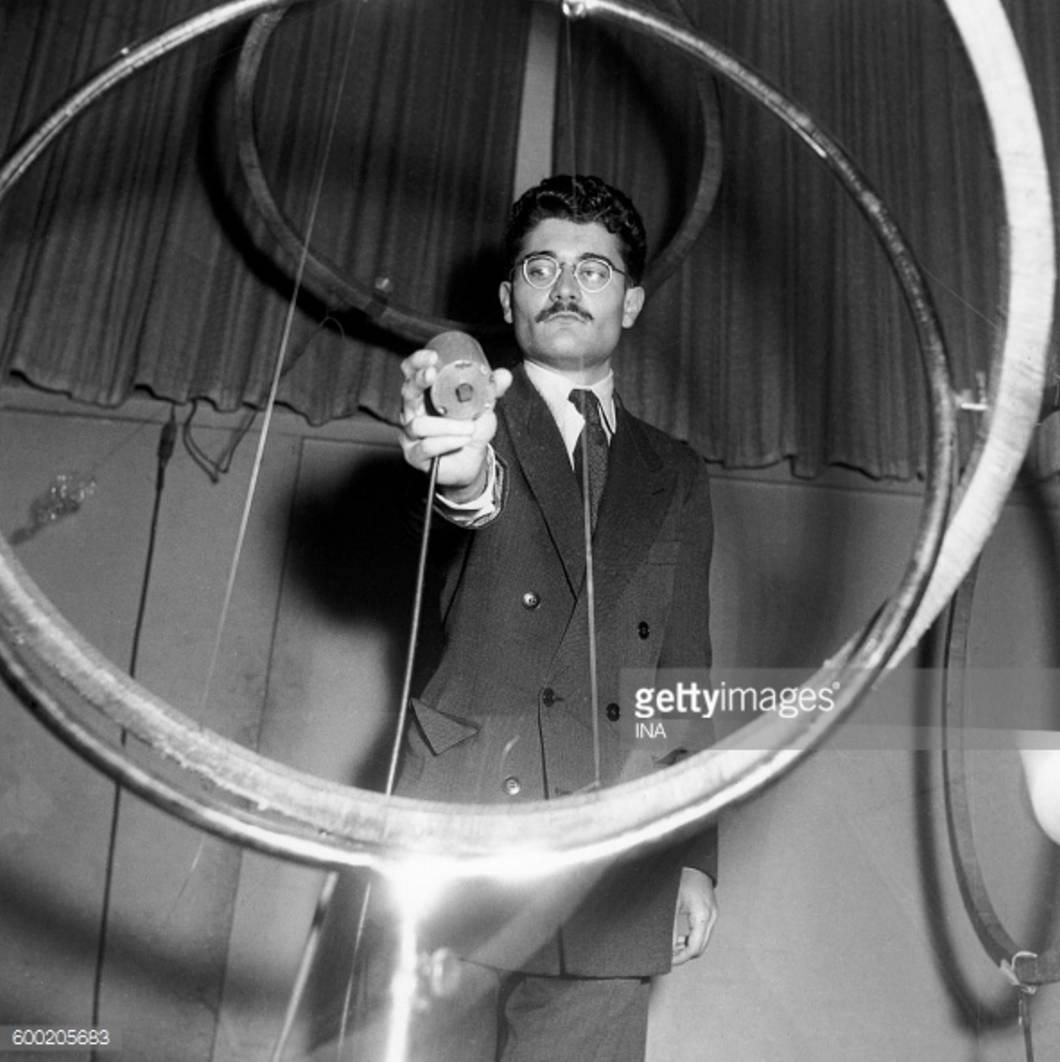


Archive of Sound Recordings at UBU Web : Pierre Henry
Frequency Ranges of Musical Instruments

Frequency Chart
This Frequency Chart is from the excellent : http://www.sengpielaudio.com/
Download the PDF of the original chart here: Frequency Chart
IPEM – Institute for Psychoacoustics and Electronic Music
“IPEM’S HISTORY: IPEM was founded in 1963, as a joint venture between the Belgian Radio and Television broadcasting company (BRT) and Ghent University. The idea was to combine audio engineering with music production, thus building a bridge between scientific research and artistic research. The institute was first located in the electronics laboratory of Prof. H. dr. ir. Vuylsteke, but soon after it was associated with the department of musicology, which was lead by Prof. dr. J.L. Broeckx and later on by Prof. dr. H. Sabbe. Together with ir. W. Landrieu, they developed the institute into a music studio and a center for the study of contemporary music. Music production at IPEM was lead by the composers L. De Meester, K. Goeyvaerts and L. Goethals, all employed by the BRT. They realized many compositions and radio transmissions related to contemporary music. Since 1968, research results at IPEM were published in yearbooks. In collaboration with Sonology (then at Utrecht), this resulted in 1972 in an international journal, called Interface.”
From: Journal of New Music Research


Composer Micheline Lesaffre at Brussels’s Musical Instrument Museum (MIM

David Van de Woestijne operating an echo and reverb machine (circa 1963).

Sound technician Ivan Schepers at work in IPEM’s Muinkaai studio (early 1980s).

Composer Louis De Meester at work in IPEM’s Technicum studio (circa 1963)

Landrieu’s mixer with filters.

Generator bank with sine wave oscillator group, developed by Walter Landrieu

Landrieu’s electronic organ (based on a design by Hubert Vuylsteke).

A generator group developed by Walter Landrieu.
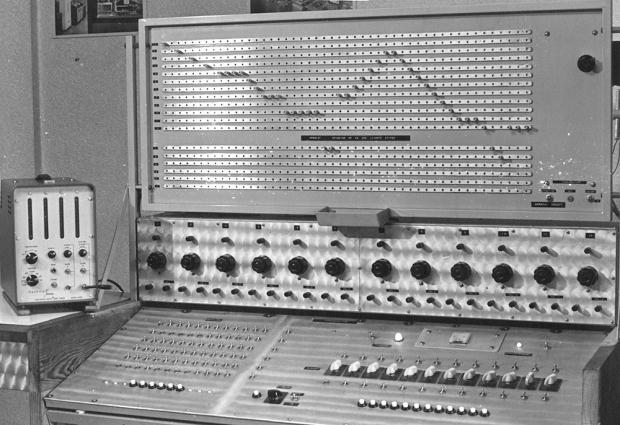
Landrieu’s electronic organ (based on a design by Hubert Vuylsteke).

The mechanics lab at IPEM’s Muinkkaai space (1965–1970).

The insides of a Melowriter.

The Melowriter – a kind of music typewriter – designed at IPEM in 1976 by Hans Janssen. The Melowriter allowed users to notate compositions into an 8 bit code.

Composer Robin Heifetz on the piano at IPEM’s Muinkkaai studio. This photo was taken by Michiel Hendryckx to illustrate Heifetz’s piano and tape composition That Which Is The Beginning
Images from WikiMedia


IPEM – Institute for Psychoacoustics and Electronic Music : ’50 years of electronic and electroacoustic music at the Ghent University’
In commemoration of IPEM’s 50th anniversary, Metaphon presents next to the CD edition (2 CD’s with lavishy illustrated 88 page book) a deluxe vinyl edition containing 3 LP’s with the book and the 2 CD’s (same material as the LP’s) all housed in a hardboard linen LP box. From the huge archive of IPEM recordings a selection was made featuring works by Lucien Goethals, Didier Gazelle, Louis De Meester, David Van de Woestijne, Stefan Beyst, Helmut Lachenmann, Boudewijn Buckinx, Karel Goeyvaerts, Emmanuel Van Weerst, Peter Beyls, Raoul De Smet, Frank Nuyts, Ricardo Mandolini, Peter Schuback, Stephen Montague and Yves Knockaert. All tracks were recorded at the IPEM studio and mastered from the original tapes. Most tracks are previously unreleased.
Book & CD Available Here : IPEM
Internet :
http://www.thewire.co.uk/galleries/photo-gallery_institute-for-psychoacoustics-and-electronic-music
http://www.mim.be/the-ipem-studio-equipment?from_i_m=1
Proportion in Musical Scales | Sacred Geometry
“Sacred Geometry is the geometry underlying Life in all of its forms. We can see it everywhere in Nature. In this context the word Sacred has nothing to do with religion. This site is devoted to the study and dissemination of knowledge about Sacred Geometry. I work to keep it as simple as possible, because there is no commercial interest behind it.”
Link to Website
Proportion in Musical Scales


MIMO – Musical Instrument Museums Online
Explore the world collections of musical instruments:
Welcome to the world’s largest freely accessible database for information on musical instruments held in public collections. Our database now contains the records of 55535 instruments.


 Binary Heap